Fifty and counting
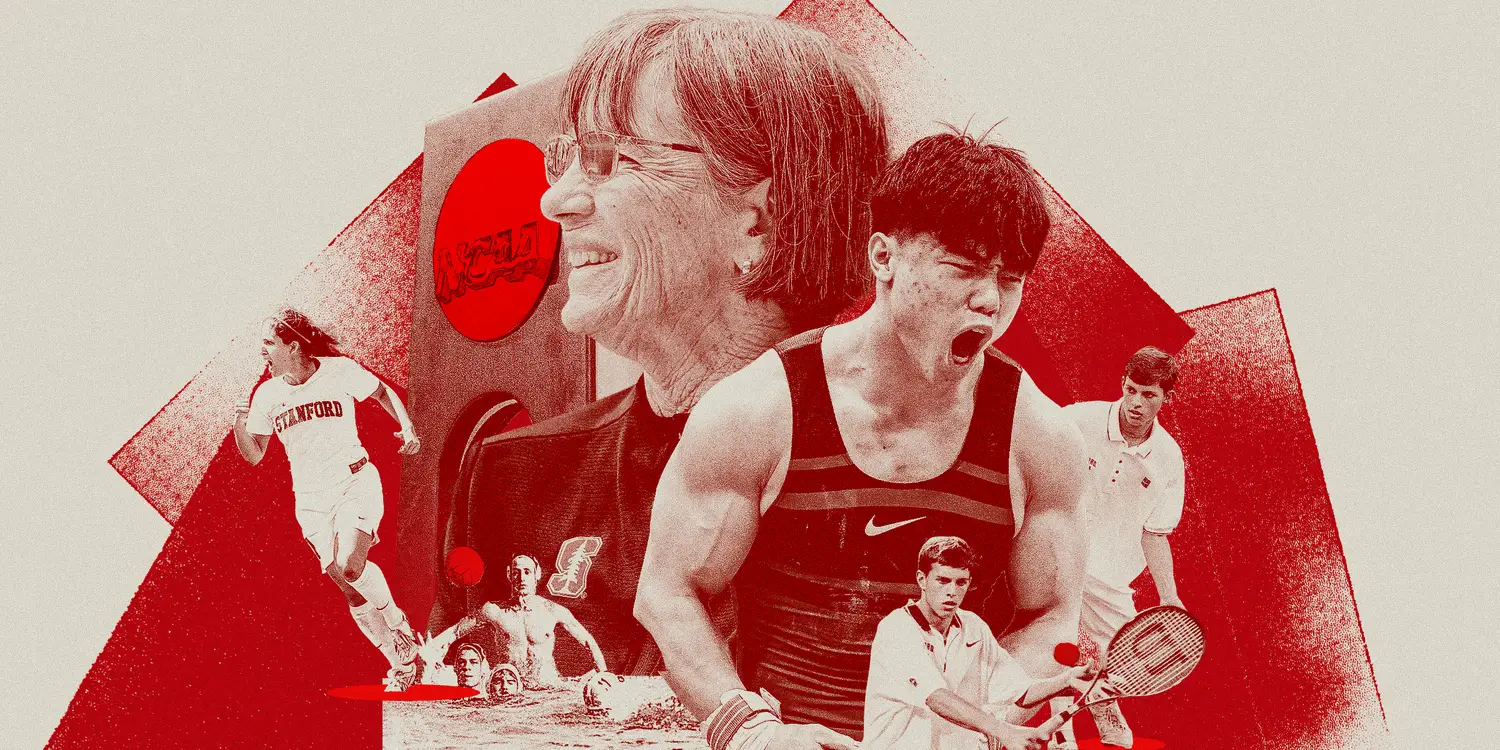
Stanford has won an NCAA championship every year for half a century—the only school to do so. From a 1976 water polo final to a 2026 rings routine, five champions trace the streak, and the lives it launched.
Story tags:
You’d think half a century of wins would let you rest on your laurels.
Not so. When Stanford folks think of “the streak,” the longest championship run in the history of American college sports, each win simply becomes fuel for the next challenge.
Maybe that’s not altogether shocking for a university that aims high. But the origins of this dynasty were humble: a single Long Beach swimming pool in 1976. There, the Stanford men’s water polo team beat UCLA by a single goal and set in motion something that nobody could’ve imagined. Fifty consecutive victories, 19 sports, 126 championships, uncountable dawn practices.
To celebrate this achievement, we wound our way back through the years, chatting with a different champion from each decade. The lessons they learned here have carried into corporate boardrooms, nonprofits, tech firms, courtrooms, and hospitals.
What’s easy to miss, amid all the trophies, is what it’s actually taken to sustain that streak: remarkable talent, yes, but also the rare habit of trying hard at more than one thing at a time. What these championships represent is 50 years of proof that Stanford student-athletes need not choose.
AsherHong,’26
The routine that completed a streak—and a launchpad toward Los Angeles 2028

Hong helped Stanford earn its 11th men’s gymnastics national championship, and the university’s 50th consecutive year of the streak. Photo: Karen Hickey/ISI Photos
2016–2026
Asher Hong hovered midair, his body a perfect plank. Gripping a pair of rings with chalky hands, he whipped around in graceful arcs before landing effortlessly. He raised his arms into the air and smiled. “I think I knew,” he says.
The scoreboard soon confirmed it: Hong’s routine had earned a 14.3, clinching the 2026 NCAA men’s gymnastics title for Stanford. The team exploded in cheers. As Hong, who was captain, walked to the podium, someone handed him a T-shirt that said “50 Straight Years of Champions.” That’s how he learned he’d been the one to cement Stanford’s streak of national wins. (His reaction now is characteristically humble: “To be able to contribute to that is pretty special,” he says.)
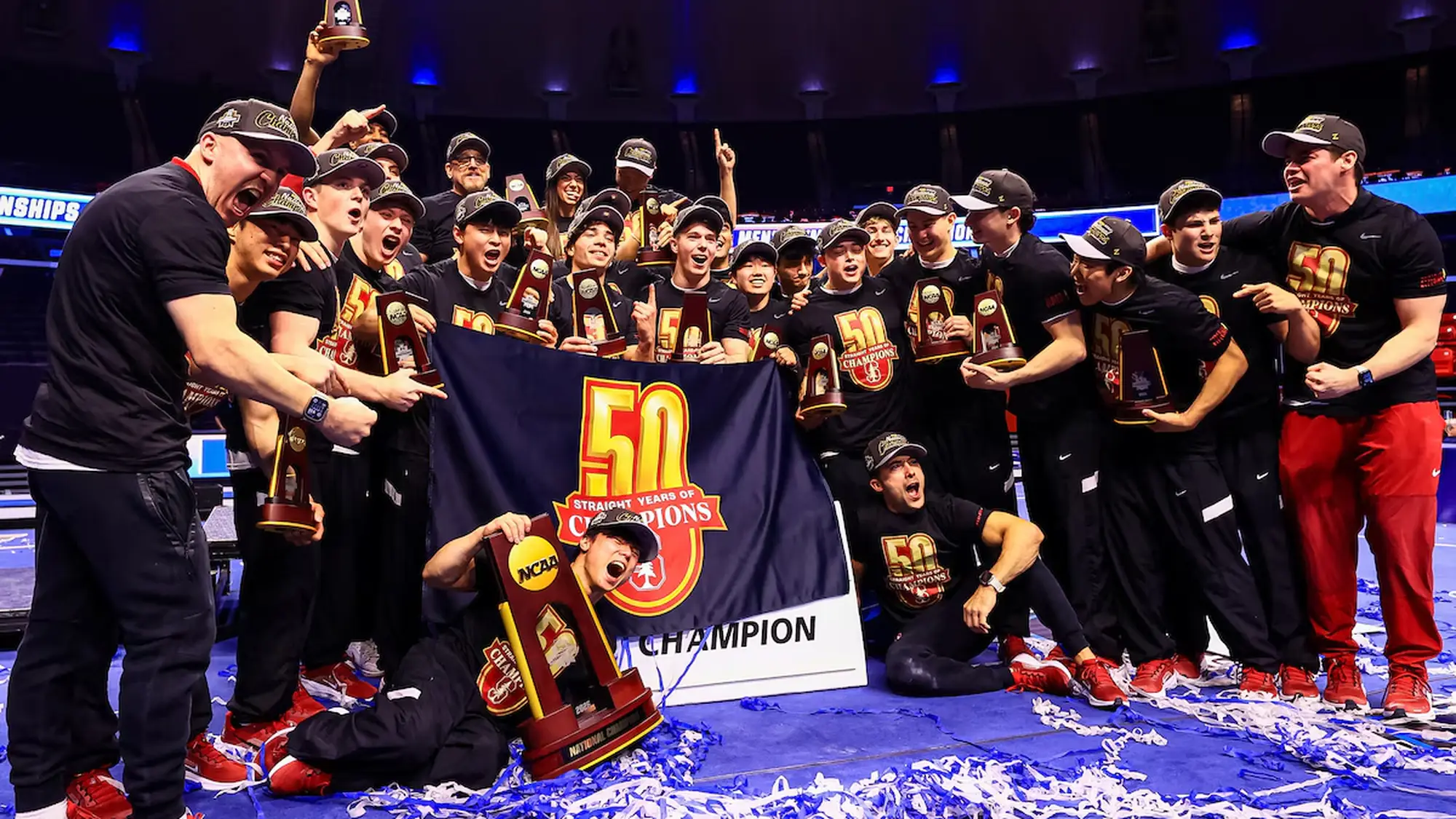
The 2026 NCAA men’s gymnastics champions. Photo: Courtesy of Stanford Athletics
Hong is no stranger to athletic achievements: He’s won six individual NCAA titles and 12 All-America honors, and he helped Team USA take home bronze at the 2023 World Championships and 2024 Paris Olympics. Now, he’s preparing to compete in the 2028 Olympic Games in Los Angeles. But he believes training at Stanford is a singular experience: “There’s an openness, accountability, and trust between teammates that helps you stay on the road to your goals,” he says.
Hong’s career has been measured in tenths of a point. At Stanford, he found a community that holds itself to the same standard—engineers, musicians, biologists, all with that same contagious ambition. He’ll carry it with him to Los Angeles.
Teresa Noyola,’12, MS ’24
A champion who traded midfield vision for code

“I never felt like I had to choose. There literally wasn’t any other school that allowed both of those parts of me at the highest level.” Photo: Jim Shorin
2006–2015
Teresa Noyola remembers the play clearly: receiving a pass, racing toward the goal, and sneaking the header past Duke’s goalkeeper into the back post. The goal, during Noyola’s senior year in 2011, won Stanford its first NCAA women’s soccer championship. Noyola also took home the Hermann Trophy, the highest individual award in college soccer.
Noyola considers the victory a group effort. “We had great chemistry as a team,” they say. “Everyone was supportive of each other.”
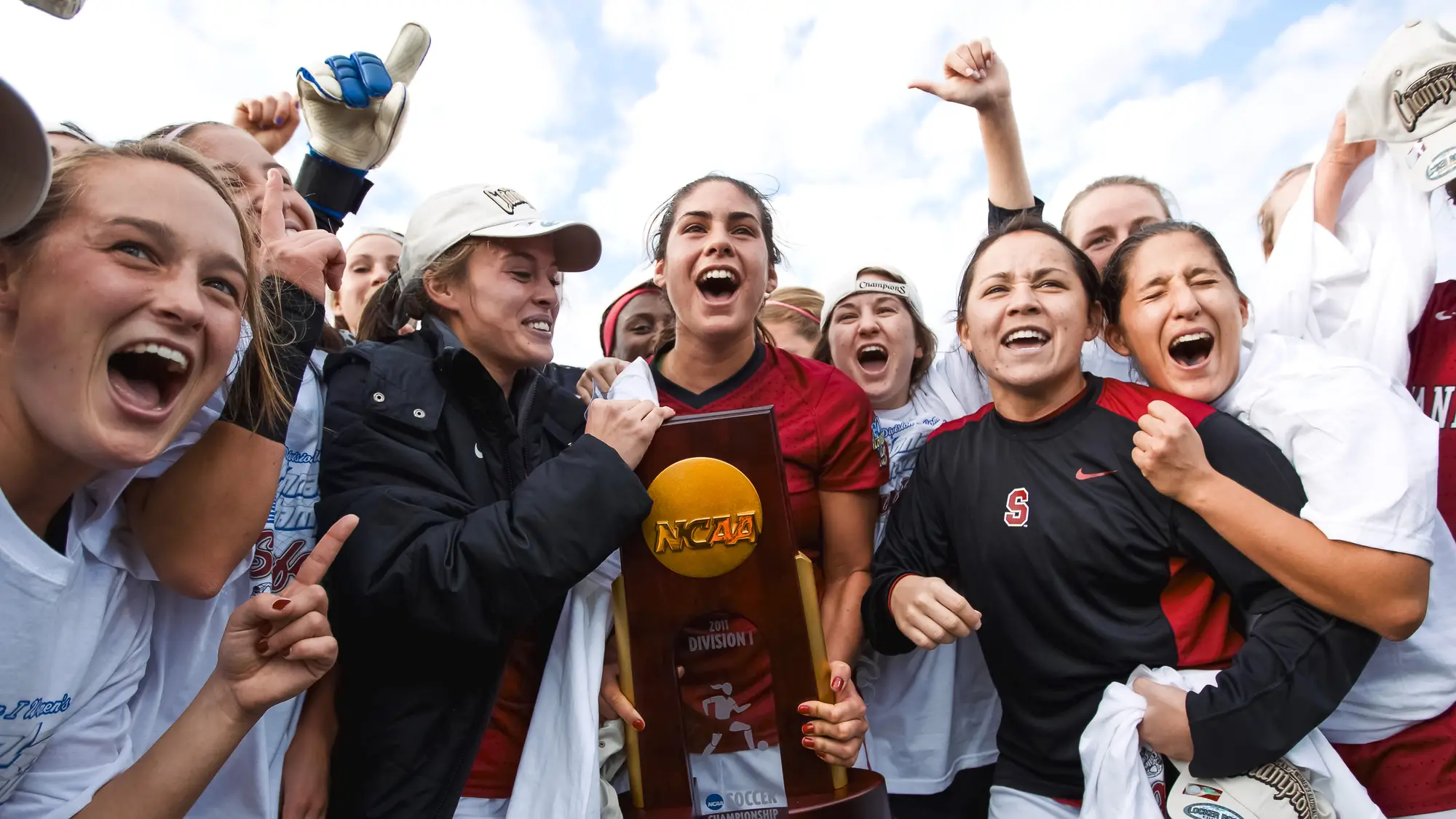
The 2011 Women’s College Cup champions. Photo: Steven Limentani
Noyola, whose position is attacking midfielder, went on to a career in professional soccer, playing for teams across the United States and in Mexico, Iceland, Japan, and the Netherlands. After retiring in 2018, they returned to Stanford to earn a master’s degree in computer science. Noyola credits an undergraduate course with lecturer Julie Zelenski for sparking their interest in the field.
“Stanford really provided an environment where I could get the best of my athletic and academic potential,” they say. “I never felt like I had to choose. There literally wasn’t any other school that allowed both of those parts of me at the highest level.”
Since 2023, Noyola has worked as a full-stack developer at Byga, a software platform for youth sports organizations. Skills honed on the field are serving them well in the second chapter of their career. Communication, teamwork, and leadership, they note, are as useful in a code review as in a championship final—and they’re helping build the tools to get another generation onto the field.
Bob andMike Bryan
Turning a brotherly bond into the winningest run in doubles history

The Bryan brothers helped Stanford win back-to-back NCAA team titles. Photo: Kyle Terada
1996–2005
Before Bob and Mike Bryan arrived at Stanford, the identical twins and tennis stars had been inseparable. But freshman year, they found themselves in dorms on opposite sides of campus. Developing their own identities, they say, helped them on the court and throughout their lives.
“Stanford helped us grow up individually, which ultimately helped us become a better team,” Bob says.
The brothers helped Stanford’s men’s tennis team capture national team titles in 1997 and 1998. After going pro in 1998, they became the most successful men’s doubles team in tennis history, winning a record 119 titles together, including 16 Grand Slams. They earned Olympic bronze in 2008 and gold in 2012. Since retiring in 2020, the pair have continued to play tennis, while coaching and running a nonprofit that supports youth through tennis and the arts. Bob also serves as captain of the U.S. Davis Cup team.
Bob credits Stanford, especially legendary coach Dick Gould, with instilling a growth mindset.
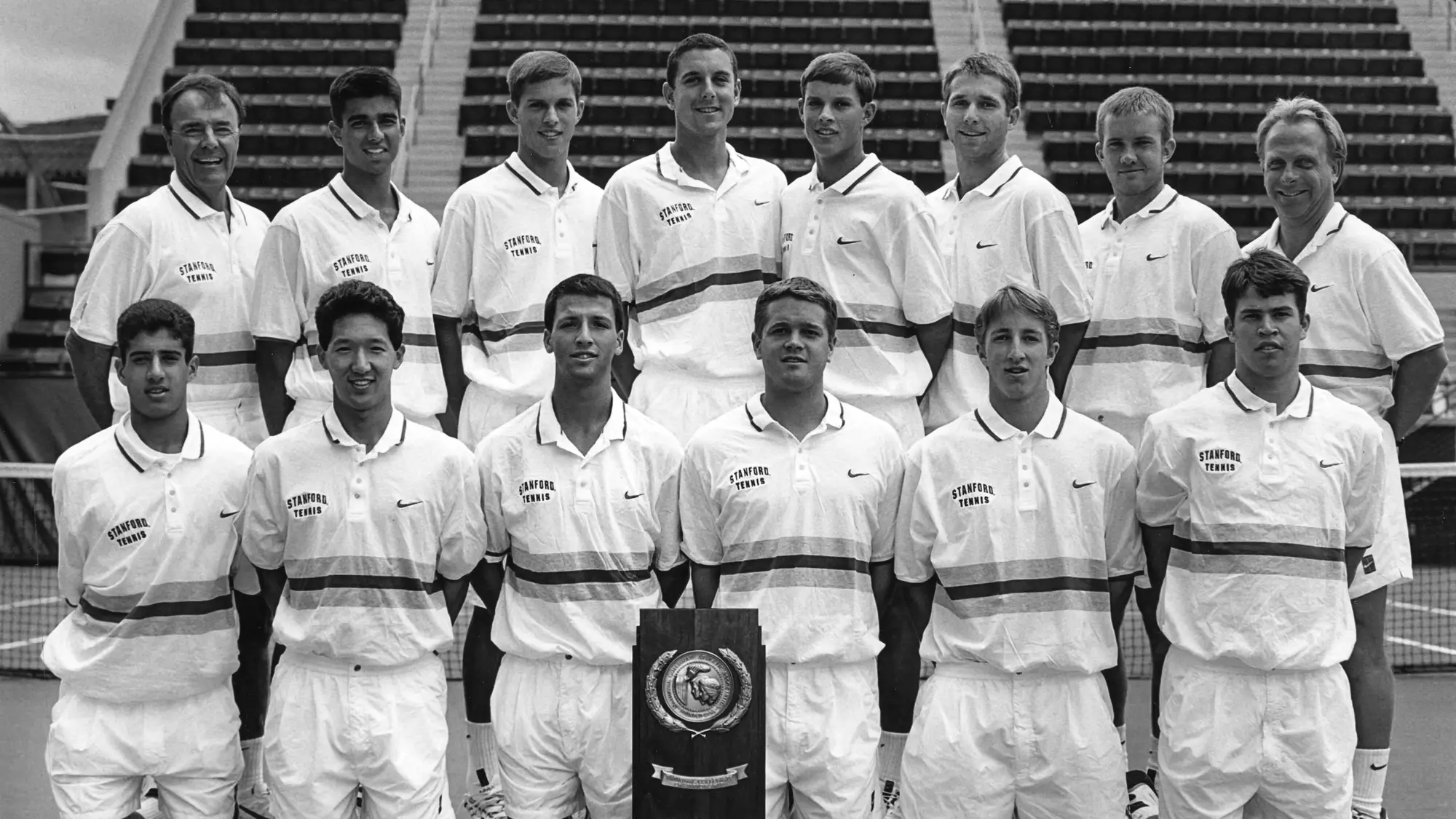
The 1997 national championship team coached by Dick Gould (Top left). Photo: Steve Lacey
“We didn’t just go out and hit tennis balls. We always had something we were trying to improve,” he says. “It applies to life after tennis, too. As a husband, dad, captain, there’s always something I can learn and something I can do better.”
He says the brothers’ success would not have been possible without the strong community they found at Stanford. “You had teammates pushing you, coaches believing in you, professors challenging you, and the entire athletic department supporting you,” he says. “The trophy might have 10 guys standing around it in the picture, but there are a hundred people who helped put it there.”
TaraVanDerveer
A Stanford legend who built a basketball dynasty from scratch

Since 2024, the court at Maples Pavilion is known as Tara VanDerveer Court to honor her extraordinary career. Photo: Karen Hickey/ISI Photos
1985–1995
When Tara VanDerveer took over as Stanford’s head women’s basketball coach in 1985, the team had never won a national championship, or even gotten close. But she saw potential. “I just believed that young people wanted a combination of a great education and great teams,” she says.
Five years later, despite only having 11 players, the team did something many considered unthinkable: It won its first NCAA national championship, defeating Auburn University 88–81. “We were on fire,” VanDerveer recalls. “It was a little bit surreal.”
The fire only grew. Before she retired as the Setsuko Ishiyama Director of Women’s Basketball in 2024, the team made it to the Final Four 15 times and won national championships again in 1992 and 2021. She amassed 1,216 victories over 45 seasons, becoming the winningest coach in the history of college basketball at the time.
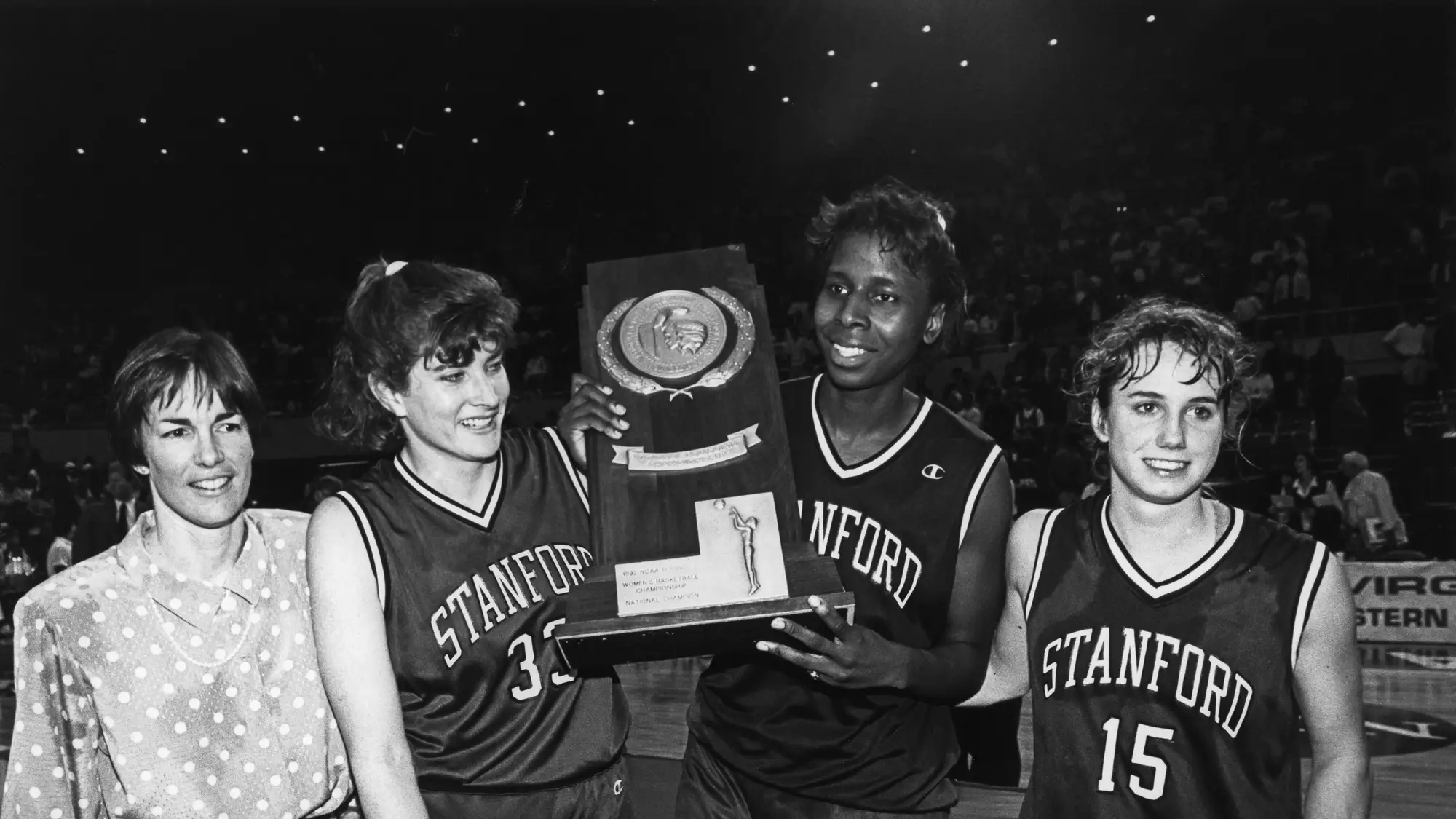
Hall of Fame coach Tara VanDerveer led Stanford to three NCAA titles. Photo: Norm Schindler
“We worked hard to recruit great players and we worked hard to develop them,” she says. “They’re super competitive in the classroom and on the court. We’re proud of having the best of both worlds.”
Alums include Nneka Ogwumike, ’12, who was named one of the WNBA’s top 25 players of all time; Chiney Ogwumike, ’14, an ESPN commentator; Evon Asforis, ’90, a New York county judge; and Christina MacMurdo, ’92, an internal medicine doctor. “We recruited phenomenal women who were not just talented but had the ability to work hard and be disciplined,” VanDerveer says.
Looking ahead, she is confident that Stanford has what it takes to sustain its track record of excellence. “I think we should go for a 100-year streak,” she says. “If we could do it once, we could do it again.”
Christopher Dorst, ’77, MBA ’82
An underdog splash that launched a 50-year reign

Dorst was the team captain of the 1976 Stanford men’s water polo team. Photo: Chuck Painter
1976–1985
In Christopher Dorst’s den sits a Lucite block inscribed with the NCAA logo. It commemorates the first time Stanford’s men’s water polo team won a national championship, in 1976, with Dorst as goalkeeper.
The accolade is more than a family keepsake. Dorst’s win kicked off the university’s 50-year streak of national championship triumph. Dorst’s team had refined their game by playing formidable opponents across the Soviet Union and Europe. By the time they faced UCLA in 1976, something had clicked into place.
“I just remember thinking, ‘We got this,’” Dorst says. “All the effort and pain and setbacks—everything that goes into being an athlete of that caliber—gets validated by the team doing well.”
After graduating with a history degree, Dorst went on to take home the silver in the 1984 Olympics. He earned an MBA at Stanford, then worked as a marketing executive and eventually returned to Stanford Athletics as director of guest services for more than 13 years before retiring in 2025.
His sports acumen proved helpful throughout his career: “You’re used to competing, training, showing up, and working hard,” he says, “and you also know how to deal with failure and level up.”
On the shelf beside Dorst’s award rests an oblong wooden trophy. His daughter Emily, ’15, earned it in 2014, playing the same position for the same university in the same sport. That win helped preserve the streak her father helped start. (Emily’s team also won national championships in 2012 and 2015, and her mother, Marybeth Linzmeier, ’85, won 11 NCAA individual titles with the Cardinal swimming and diving teams.)
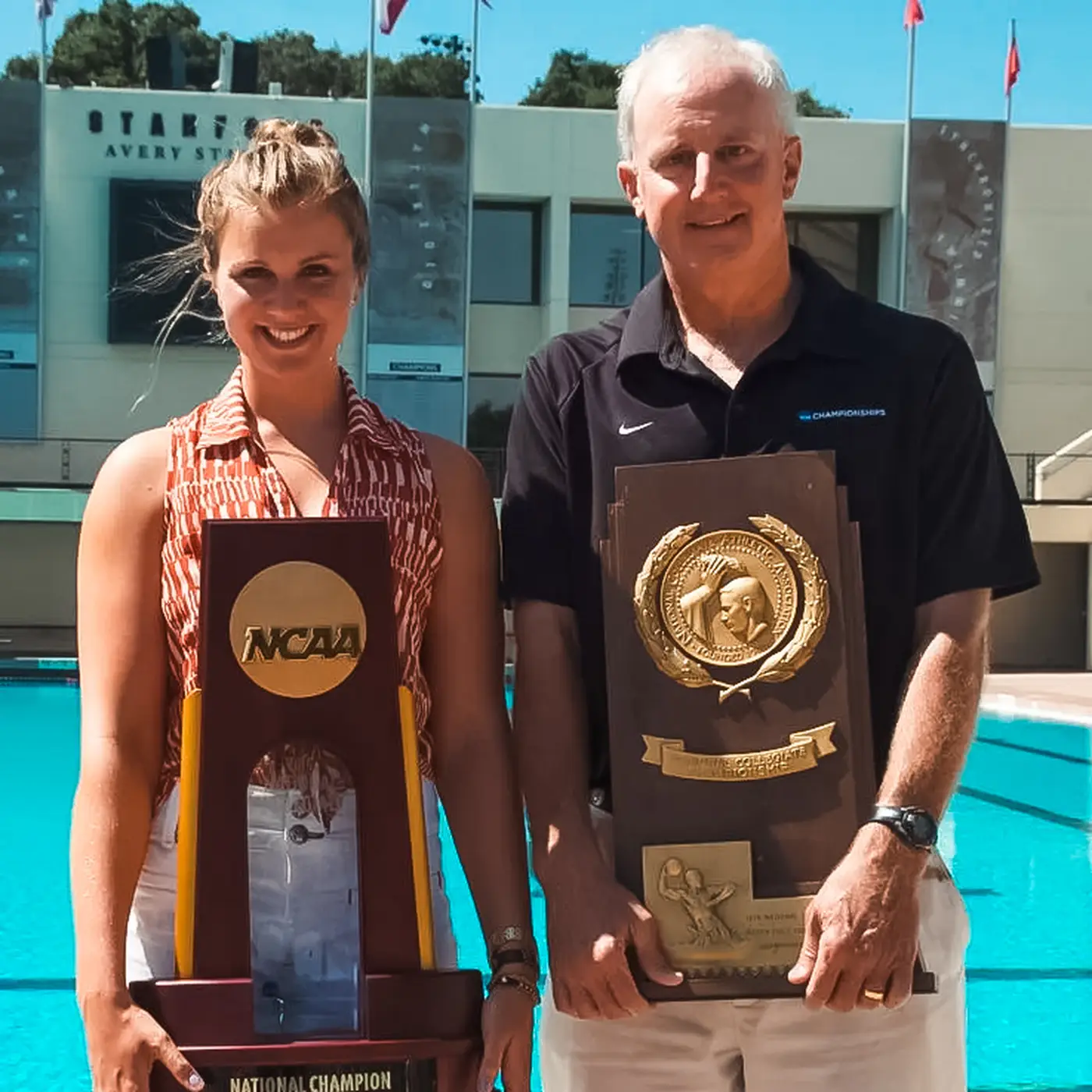
Goalkeepers, father and daughter: Christopher and Emily Dorst with their NCAA water polo trophies from 1976 and 2014. Photo: John Tanner
Though it’s been half a century since Dorst’s momentous victory, some things haven’t changed. “What’s true now was true then: The Stanford way of doing things is about excellence,” he says. “Whether you’re in the pool, the classroom, or the lab, you give it the best you’ve got. That may be the secret sauce.”
Meanwhile it all continues. Somewhere on campus right now, the next champion is already in the pool, or the gym, or the library, getting a head start on No. 51.


