The market with no prices
Every year, kidney disease claims some 1.5 million lives worldwide. Nobel laureate Alvin Roth helped design a system that turns willing but incompatible donors into lifesaving ones. With support from Stanford Impact Labs, he’s bringing it to countries where the need is greatest.
Story tags:


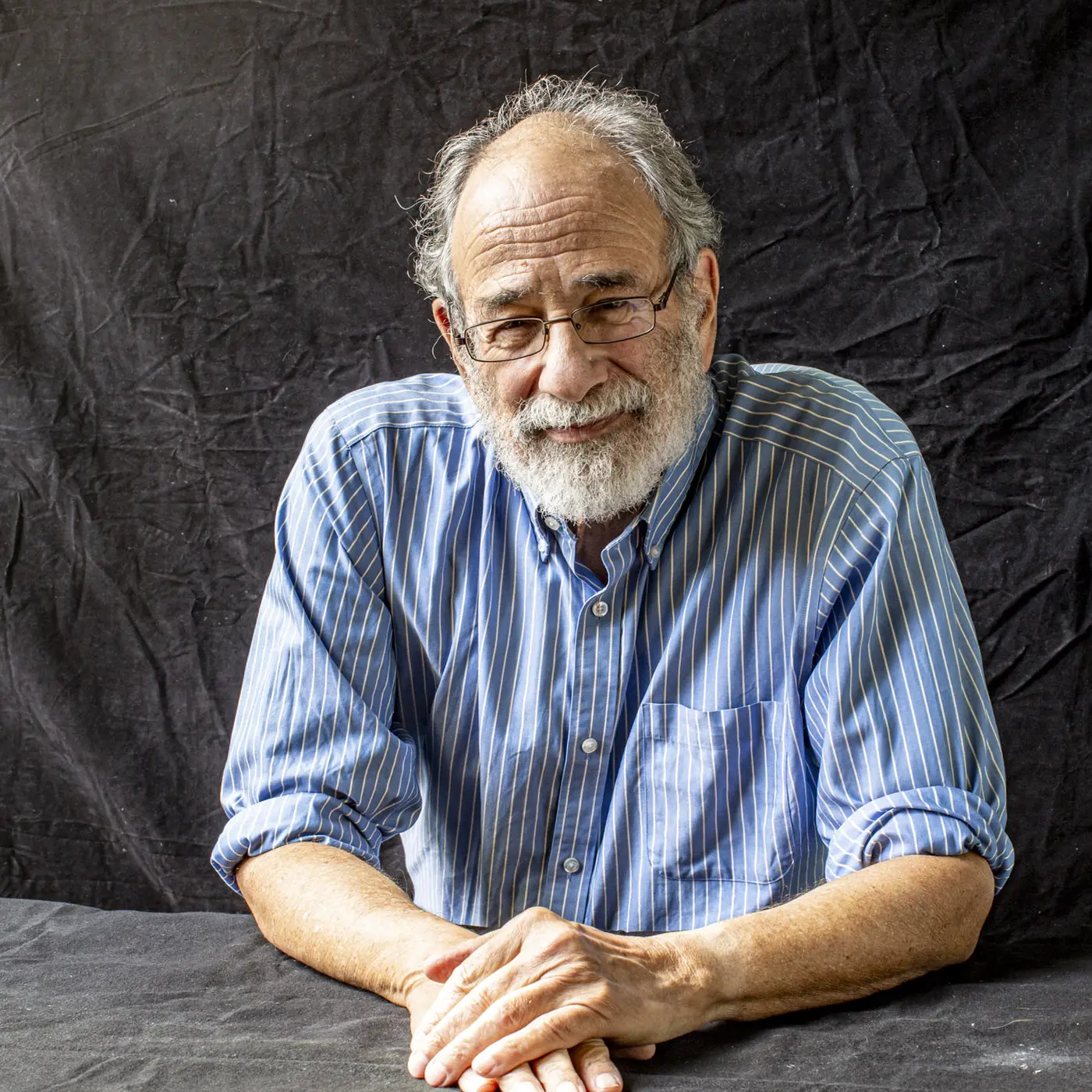
Alvin Roth. Photo: Timothy Archibald
Share this story
Alvin Roth, PhD ’74, first came to Stanford as a graduate student in operations research. He eventually joined the faculty of the University of Pittsburgh in 1982. Pittsburgh was home to a medical center that was a hub for organ transplantation.
He soon saw a fundamental challenge: Kidney transplants save lives, but there was a problem of supply and demand. To survive, patients with kidney failure either had to match with a deceased organ donor, or find a willing friend or relative with a suitable kidney they could donate. Often, neither option materialized.


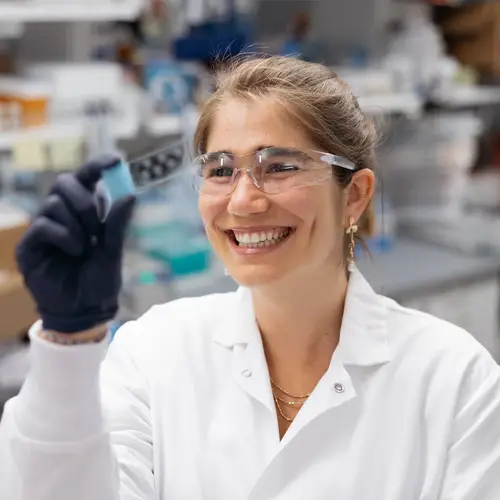
Before kidney exchange, Roth used similar economic principles to match new doctors to residency programs. The algorithm he co-designed for the National Resident Matching Program, first used in 1998, still pairs tens of thousands of applicants with residencies each year. Photos: Timothy Archibald

The solution, it turned out, lay not in medicine but in economics. Working in the early 2000s—by then as a professor at Harvard—with transplant surgeon Michael Rees, then at the Medical College of Ohio in Toledo, Roth helped design an algorithmic system for matching incompatible donor/patient pairs with other pairs in the same situation: a kidney exchange. It was a rare case of mathematical theory solving an urgent problem in health care, and it helped earn Roth the 2012 Nobel Prize in Economic Sciences, shared with mathematician Lloyd Shapley. That same year, Roth returned to Stanford, this time to join the faculty.
Now, with support from Stanford Impact Labs (SIL), Roth and Rees are taking the model global. Their research project, Extending Kidney Exchange, is working with doctors and government agencies in India and Brazil to establish similar systems. “For kidney exchange to work at scale, you need a large population,” Roth says. They chose India in part because it has a population of 1.4 billion and also a high donation rate—the most after the United States and China. The problem is that Indian law currently requires living donors to be a relative or spouse. “So changing that could potentially save a lot of lives,” Roth says.
“In both locations, we’re using everything we’ve learned from 25 years of doing this work in the United States to hopefully jump-start similar programs in these countries,” Rees said in 2024. “There is tremendous opportunity if we can get kidney exchange to work in both these places, and SIL funding will help us figure out how to do it … and help our international colleagues build policies to support it.”
The idea for kidney exchange grew out of an insight Roth had while at Pittsburgh: In some cases, there were people willing to donate who weren’t a biological match—a sister who didn’t match her brother, say. What if there was a way to find another pair in a similar situation, and engineer a mutually beneficial swap? That way both patients would be saved, and no potential donors would go to waste.
“In economics, generally, we care not just about allocating scarce resources. We also care about making them less scarce. And market design is getting into the details of that in particular markets. How can we allocate scarcity efficiently and how can we make things less scarce? There aren’t enough transplants for all the people who need them, and market design is about figuring out the details of how to ameliorate some of that scarcity.”
Alvin Roth
Today, in addition to simple paired swaps, there are chains involving a series of patient/donor pairs, each receiving a kidney and then donating on to the next person in line. (While this chain could theoretically be a closed loop, where the last donor matches with the first patient, it more often begins with the addition of one altruistic donor, who gives a kidney without the expectation of getting one for a family member in turn.) Currently, the record for the longest chain in the United States led to a stunning 35 transplants.
The need for a large population to effectively match donors and patients also means that in smaller countries, like Uruguay or Denmark, patients can end up with no options. That’s especially true for those who are highly sensitized—meaning very hard to match—and for whom an international match might well be the only option. To address this, Roth has urged governments to consider allowing cross-border kidney exchanges, like one that recently took place between three patient-donor pairs, two in Israel and one in the United Arab Emirates.
That kind of cooperative donation across borders remains challenging, Roth admits—both logistically and because of concerns about organ trafficking, where people from poorer countries sell organs to wealthy patients. But with a kidney exchange, he explains, exploitation isn’t an issue, because each pair donates a kidney and receives a kidney.
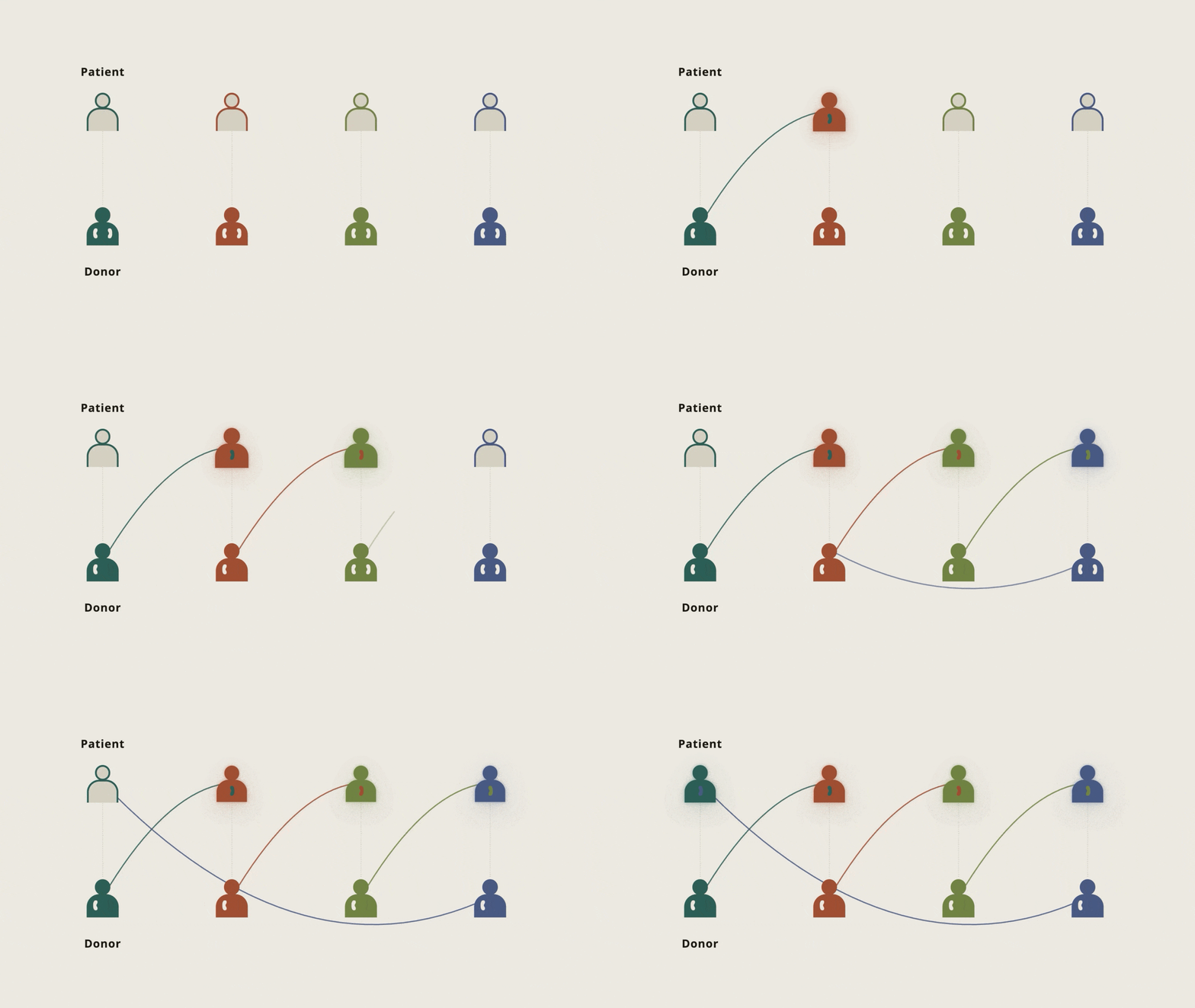
“In a miraculous way, this donor can work for this patient, and this donor can work for this patient. Why don’t we just let them exchange it? It is people allowing their donor to donate a kidney to another patient, and that patient's donor donating a kidney to someone else, and thus creating a chain in which everyone gets a donor.”
In his new book, Moral Economics: From Prostitution to Organ Sales, What Controversial Transactions Reveal About How Markets Work, Roth argues that the real reason many countries resist kidney exchanges is ideological. “There’s this dogma that countries have to be self-sufficient when it comes to organ donation,” he says. “But as an economist, that doesn’t make sense. We don’t expect countries to produce all their own cars, or food, or other clothes.”
Eventually, Roth says, he hopes to establish kidney exchanges in even more countries. Roughly 1.5 million people die from kidney disease each year, making it one of the top 10 causes of death around the world. The surge is largely a side effect of other epidemics. Diabetes and high blood pressure, the two leading causes of kidney failure, are climbing worldwide as populations age and diets change. Because damaged kidneys rarely announce themselves until late into disease, many patients learn they’re sick only when they need dialysis or a transplant. “So introducing the idea of kidney exchange, and ideally establishing chain donation, could potentially save a lot of lives,” he says.
In the U.S., some 30,000 transplants happen annually. While that number is still too low, it’s well ahead of many countries—especially those that still limit donations to close relatives. “That’s why Extending Kidney Exchange is so important,” Roth adds. “We may be short on donations here in the U.S., but in many places, the ratio is much worse.”

There is tremendous opportunity if we can get kidney exchange to work in both these places,and SIL funding will help us figure out how to do it.”Alvin Roth
School of Humanities & Sciences: The impact
Why it matters
Alvin Roth won the 2012 Nobel Prize in Economic Sciences for market design research that included helping design kidney exchange—a system that lets incompatible donor/patient pairs swap with other pairs so more transplants can happen. Now, with support from Stanford Impact Labs, he and longtime collaborator Michael Rees are taking that model global. In the United States, roughly 90,000 people are waiting for a kidney, and thousands die each year before one arrives. In much of the world the math is worse: Kidney disease is among the fastest-growing causes of death, while legal limits on who can donate leave willing givers on the sidelines. By catalyzing kidney exchange, also known as kidney paired donation, Roth’s work shows how far economic theory can travel—from a journal page to an operating room, and from one country to the next.
The opportunity
With an investment from Stanford Impact Labs, the Extending Kidney Exchange project is working on two fronts: helping transplant centers in India and Brazil build exchange programs that fit local laws and ethical norms, and testing, with Walter Reed National Military Medical Center, chains that begin with a deceased donor’s kidney. That’s an approach that could add hundreds of U.S. transplants a year. Philanthropic support for SIL enables Stanford researchers to scale proven, evidence-based solutions—like Roth’s—in service of real-world needs. Without that support, ideas like these can remain on the page rather than making their way into people’s lives.